So this morning I finished up the last issues I had targeted for iteration 9 in fogbugz. The release isn't yet ready to go out, as I have to play with the numbers to make the game fun/winnable. However, outside of bug fixes, I should be done make code changes for now.
I'm hoping that balancing should be "easy" now that I have filled in tech trees and have a reasonable spread of items, but as I've said before balancing games is hard. Do any other game developers have trouble balancing stats, abilities, items, and such to make a fun game? Any suggestions on ways to make it easier outside playing the game a bunch and make lots of small tweaks?
Thursday, August 5, 2010

Wednesday, August 4, 2010
Skill Trees "Filled Out"
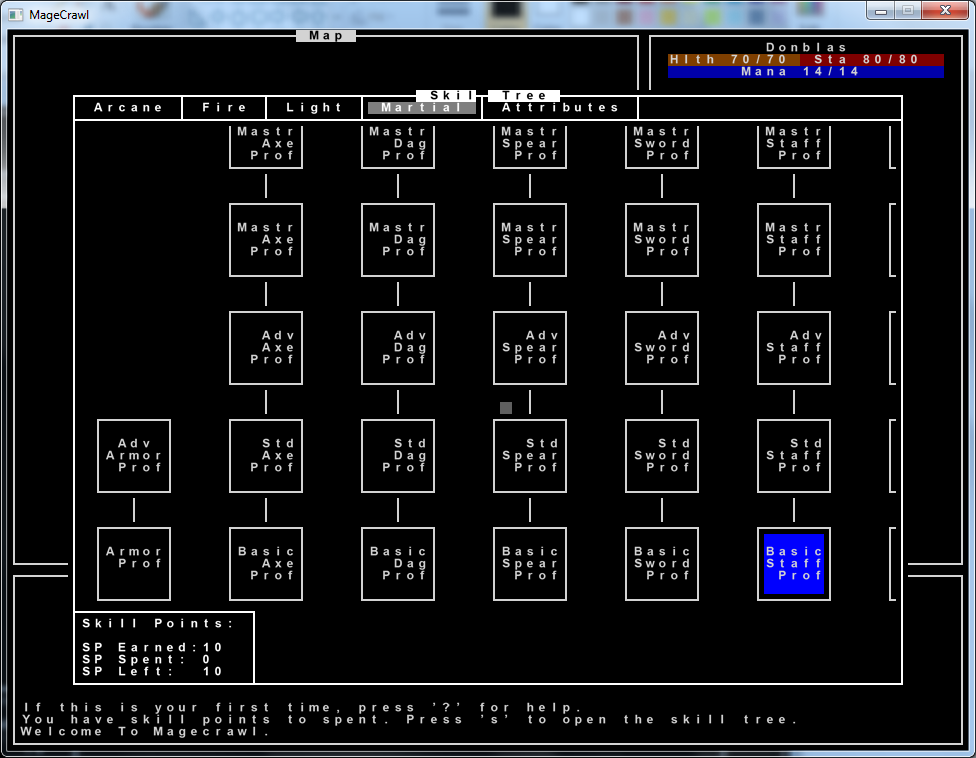
I decided to spend some time "filling out" a few skill trees, and have simple but complete trees for five sub-trees: Arcane, Fire, Light, Martial, Attributes. Each tree has between 7 and 10 node (except martial which has 37), and each node provides a new skill or improves an existing one. I still at some point need to write descriptions for the martial skills, but beyond that the skill tree is done for this iteration.




Sunday, August 1, 2010
Class vs Struct - It actually can matter
So, the second of my optimization realizations today involves the difference between structs and classes. For those who've been with this blog for awhile, you might remember a post I made half a year ago, here. In that post, I realized that a list of structs uses a lot less memory than a list of classes when each item is crazy small and there are a huge number of them.
Today, I've ran into the inverse. I made Point a struct back when I made that realization, thinking that it was small and therefore memory savings were worth the savings. However, when you stick an item into a dictionary as a key, it apparently makes a copy if it is a struct. It also makes a copy if you query the dictionary with a struct as the key. This meant I could rack up half a million or more point copies by scrolling for 15 seconds in my skill tree. This caused the memory manager to go crazy, and introduce the lag I was seeing. Switching it to a class helped a bunch.
When should you use struct vs when should you use class? Here's my current huristic:
If the item is large or you won't be having a crazy huge number of them - Use class, the possible optimization isn't worth it.
If a large number of the items will be stored in memory in a list - Try struct, as you'll save a pointer sized (4 or 8 bytes) amount for each item.
If you will be using it as a key (or value to a lesser extent) in a dictionary - Use a class, as each query on the dictionary and every access will make a copy.
GetHashCode's preformance really matters if you use it as a dictionary key alot
Just a quick post about a surprisingly small change that improved performance in magecrawl's skill tree view. I have a custom point class since there doesn't exist one inside c# outside of some GUI toolkits I don't want to force dependencies on.Since I overrode Equals, the compiler told me to override GetHashCode. I did so the naive way:
I have a spot in a tight loop that needs to lookup information based upon its position. I was previously using a List with a where LINQ call, which was insanely slow when I scaled up the number of skills. I figured this out using profiling and changed it to a dictionary. However, it was still too slow, so I read up on GetHashCode more and realized I could change GetHashCode for point to read:
I didn't keep track of the numbers, but this very visibly made a huge difference. Keep GetHashCode in mind when you have data structures that are used as keys in large dictionaries. A small change can make a big improvement.
public override int GetHashCode()
{
    return X ^ Y ^ base.GetHashCode();
}
I have a spot in a tight loop that needs to lookup information based upon its position. I was previously using a List with a where LINQ call, which was insanely slow when I scaled up the number of skills. I figured this out using profiling and changed it to a dictionary. However, it was still too slow, so I read up on GetHashCode more and realized I could change GetHashCode for point to read:
public override int GetHashCode()
{
    return X ^ Y;
}
I didn't keep track of the numbers, but this very visibly made a huge difference. Keep GetHashCode in mind when you have data structures that are used as keys in large dictionaries. A small change can make a big improvement.
Wednesday, July 28, 2010
Iteration 9 and 10 - The new plan
So, I'm changing my iteration plans around the release of a video game. Let's just put it out there. Final Fantasy 14 is being released September 30th (early access on 22nd), and I am excited enough to pre-order it. Due to that, and the expected week or two post-release that I won't involve much coding, here's the new plan.
Iteration 9 - Finishes asap. As soon as I get the game balance reasonable, and a spread of items/weapons for the 5 levels of the current dungeon, kick it out of the door. I'm planning on calling it tech demo 3.1 or something similar, just for those readers of the blog who want to see the new stuff.
Iteration 10 - Get as much done in August and September. Things like diminishing returns, school specific debufs, sound drawing monsters, etc. Also get enough of the small features done that the next "iteration" will be more of a "slice". Something where I create more interesting gameplay content and less concern on the game engine.
Tuesday, July 27, 2010
Generic can be the enemy of progress
As it was said on coding horror, "a blog without comments is not a blog". Earlier today Jotaf posted a comment on my last post that got me thinking. The post was on my work making changes to the skill tree easier, here's the meat of it:
"Nice, I agree completely, although you must always ask yourself the obvious question: "is it worth it?". Since you're gonna change the skill tree many times during balancing the answer is yes. This is almost always true for data-driven gameplay features (ie, stats, skills...). It's almost always not true ("it's not worth it!") for things that are more or less set in stone, like game mechanics, combat, AI, and I've seen many developers getting themselves into an endless loop of refactoring, because you can obviously always make future changes easier by changing your design to be more generic/plugin-driven/offloading more data or logic into external files."
I think this is true and in some cases can prevent roguelikes from ever getting completed. Since none of us get paid to work on our pet projects, the temptation is to never set deadlines or abide by them. The desire to make the code "perfect" can make us spent all of our time making the code more generic to the point we're creating a game engine more that game itself. While this can sometimes be successful (ToME being the most obvious example), for 95% of us it doesn't buy us much.
If I spend 10 hours refactoring the AI to move it to external files, and then spend only 5 hours tweaking it over the next year, the change was obviously a loss. Even if I save some time, that needs to be balanced by the fact that the code is more complicated. As opposed to a function you can debug, a problem can be in the file parser, the external file itself, the code implementing the behavior expressed in the file, etc.
I have a few suggestions for other developers based on my experiences with magecrawl that so far have mitigated this issue for me (beyond my general pragmatic attitude).
- Set deadlines, preferably short ones - When you want to finish your iteration in three months, spending a month and a half on something like swig'ing libtcod or converting libtcod's build system to cmake, makes you at least think about the trade off you are making.
- Use bug tracking software - I love fogbugz myself, but the one built into google code or even bugzilla is better than nothing. When you find something you'd like to refactor or make more generic that would take longer than 15 minutes, go add an entry for this or a later iteration and get back to what you were originally working on.
- Things that change often or by users should live in external configuration files, things that don't shouldn't - How often are you planning on changing your physics system? Even if you think this'd more more often than once, leave it hard coded for now. After the third time you mess with it, then go make it generic. By the time that third time happens, you'll probably have a better view on what to pull into data files anyway.
- You can ignore any of these rules if you want to - beyond the fact that I'm just a random blogger on the internet, you are writing your game. While I think getting a working game done early is the best way to do things, realize you are doing it for enjoyment. If spending a year writing a engine that can make toast, run a neural net AI, or show pong on the screen, all with just changing configuration files sounds fun, go get coding.
Sunday, July 25, 2010
When making a type of change in your game is tedious, first fix things so that it isn't anymore
So part of my balancing work involved buffing the player's abilities when it makes sense. One way to do this is to add new skills on the skill tree. However, the system I had in place for read/displaying the skill tree made me hesitant to do so, as even a simple change was a lot of work.
The previous system involved a text file with a grid of ascii characters laying out the exact location for each node, along with a list of positions below to match each one up with the associated skill. If I wanted to add more nodes, I'd have to manually place it, then calculate the offset and write it below. If I needed to make the grid bigger, I'd have to recalculate the offset of every node for that tree. It pretty much never should have gotten submitted in that state, but it was "good enough" for the simple trees I had implemented. The horror can be found here for those who are morbidly curious.
I noticed that all my nodes were in a grid, so I converted each text file into an xml file describing the skill tree. One example can be found here. I then wrote the xml reader and which would generate from the stored information the grid of characters to display on the screen. Overall it took about three hours to write, test, and submit.
In less time, I probably could have made my balancing changes and "got out" without making things better, but I would have been more likely to not add new skills in the future. Now adding a new skill is as easy as copy pasting an xml node and changing a few lines of text.
Subscribe to:
Posts (Atom)